Ask most people what product development will cost and they’ll think about the engineer’s rate. It’s a fair question. But after more than 15 years of designing products, I can tell you it’s rarely the thing that decides the final bill.
What really decides product development cost is the choices made at the very beginning. The material. The way it will be made. How many parts there are. How accurate each one needs to be. Get those right early and everything that follows is smoother, quicker and cheaper. Get them wrong and you’ll pay for it later, usually when it hurts most.
So rather than talk about prices, I want to walk you through how an engineer actually thinks about cost.
Where product development cost is really decided
When I started out in marine engineering, a young 20 something just out of university, I learnt this lesson quickly. A change on a sketch takes five minutes. The same change once the moulds are made, the parts are cut and the boat is half built? That’s a very different conversation.
It’s the same with any product. Every decision you make at the design stage locks in part of the cost of every single unit you’ll ever make. That’s why a good engineer will want to slow down at the start, ask a lot of questions and look at more than one idea before drawing anything in detail. It can feel like you’re not making progress. In reality, it’s where the biggest savings are made.
It all starts with a good brief
I always say the cheapest tool in product development is a clear brief. It doesn’t need to be long. It just needs to answer a few honest questions.
What does the product need to do, and where will it live? What does each one need to cost to make for the idea to work? Do you expect to sell ten a year, or ten thousand? Which features are essential, and which would just be nice to have? Will it need to meet any safety standards or carry a UKCA or CE mark?
That question about volume is the one most people forget, and it changes everything. The right design for 50 units is very often the wrong design for 50,000. Knowing it early saves a lot of redesign.
Why engineers work in stages
Good product development doesn’t happen in one long push. It moves in steps, with a pause to check at the end of each one. Engineers call these stage gates.
First, we agree what the product must achieve. Then we look at two or three ways of doing it and pick the best. Only then does the detailed design begin, followed by prototypes and testing, and finally the drawings and files that go to the manufacturer.
At each step, the design is checked against the brief before more money is spent. On more complex products, I’ll also run through what could go wrong and how badly, which engineers call an FMEA. It sounds formal, but really it’s just asking “what if?” before the customer does.
Working this way protects your budget. You never pay for detailed drawings of an idea that hasn’t been agreed.
Designing around the way it will be made
This is the part of the job I enjoy most, because it’s where the magic of an idea meets the reality of a workshop.
Every manufacturing process has its own rules. Sheet metal wants sensible bend radii and holes kept away from the bends. Welded fabrications need room for the welder to reach and a plan to stop the heat pulling things out of shape. Machined parts get expensive with deep pockets and lots of set ups. Injection moulded parts need draft angles and even walls, and every undercut adds to the cost of the tool.
3D printing is wonderful for prototypes and small numbers. However, the processes with expensive tooling, like moulding and casting, are the ones that give you the lowest cost per part when you’re making thousands. Choosing the right one for your volumes is one of the most valuable decisions in the whole project.
Prototypes with a purpose
Prototypes are where budgets most often run away, and it’s usually because a prototype is trying to answer too many questions at once.
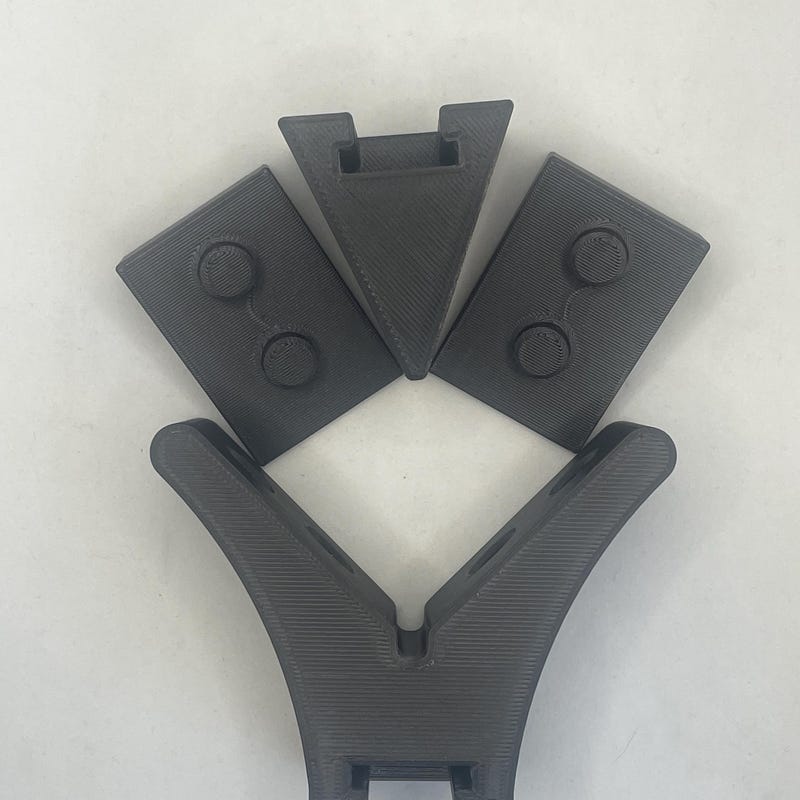
I like to give every prototype one job. Does it look and feel right? Does the mechanism work? Can it actually be made by the process we’ve chosen? Each of those is a different prototype, and most products need more than one round. Planning for that from the start is far better than hoping the first one is perfect. It rarely is, and that’s absolutely fine. That’s what prototypes are for.
Keeping product development cost predictable
Engineering work is usually priced either by the hour or as a fixed price. Hourly suits early, exploratory work. A fixed price suits a clearly defined job. Lots of projects use both.
Whichever way you go, two simple habits keep things on track. Write down exactly what’s included before work starts. And agree any change in writing, with what it means for time and cost, before anyone acts on it. Projects rarely go over budget because of one big change. It’s nearly always lots of small ones that nobody wrote down.
If there’s one thing I’d like you to take away, it’s this. The rate on the invoice matters far less than the decisions made in the first few weeks. Get those right, and your idea has every chance of becoming a product that works, looks great and makes sense to manufacture.
Have an idea you’d like to talk through?
Send me your sketches, photos or notes and I’ll tell you honestly where you are and what the next step should be. You can also read about my product development services or see some real projects.
About the author. Ben Sturgeon is a mechanical design engineer with a BEng (Hons) in Mechanical Engineering. His career began in marine engineering, and over 15 years he has designed for agricultural machinery, marine, and electronics and lighting. Read more about Ben, or email him at ben.sturgeon.design@gmail.com.